
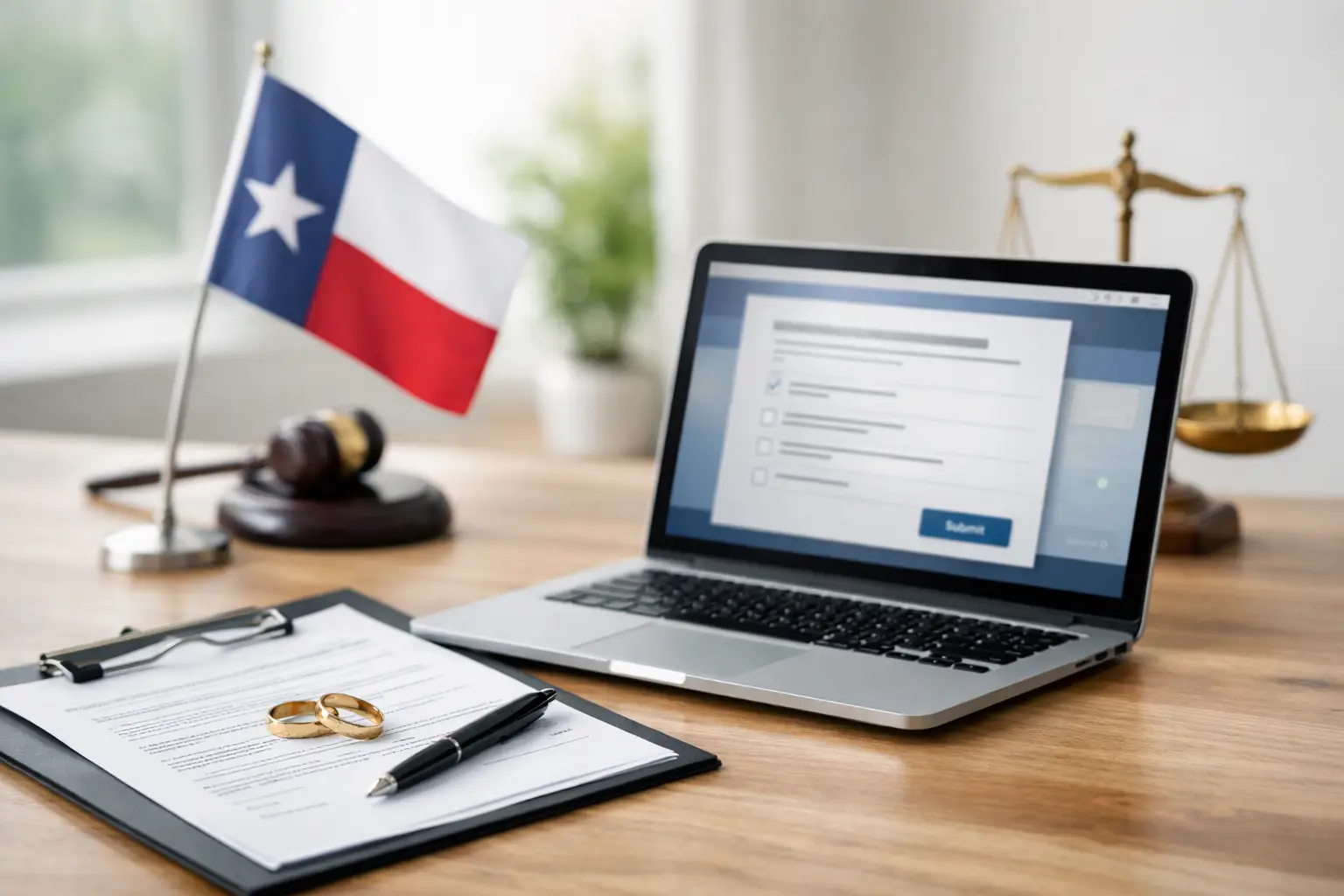
A divorce can feel stalled before it even begins when you are staring at court forms, filing fees, and unfamiliar online portals. This Texas efile divorce guide explains what electronic filing does, what it does not do, and how to approach the process with a clear plan. For many Texans pursuing an uncontested divorce, e-filing can reduce trips to the courthouse and make it easier to monitor paperwork, but it still requires accurate documents and attention to county-specific requirements.
What E-Filing Means in a Texas Divorce
E-filing is the electronic submission of court documents through an approved filing system. Rather than handing your Original Petition for Divorce to a clerk at the courthouse, you upload it online, select the correct court and case type, pay required fees or submit a fee-waiver request, and wait for the clerk to review the submission.
The clerk’s acceptance starts the court case. It does not mean a judge has approved your divorce, your agreements, or your Final Decree of Divorce. A divorce still moves through the required legal steps, including notice to the other spouse, the Texas waiting period in most cases, and final court review.
Texas courts use a statewide e-filing framework, but filing practices can differ by county and by court. Some counties have local rules about document formatting, hearing settings, proposed orders, or whether self-represented parties may use another filing option. Check the requirements for the county where your case should be filed before submitting documents.
Is E-Filing Right for Your Situation?
Electronic filing is often a practical choice when both spouses agree to divorce and have worked out the major terms. That may include property and debt division, whether either spouse will change a name, and, if there are children, conservatorship, possession schedules, child support, medical support, and insurance.
It is less straightforward when you do not know where your spouse is, expect them to dispute the divorce, need emergency orders, or have complicated assets such as a business, retirement accounts, significant real estate, or a high-conflict custody disagreement. E-filing may still be available in those situations, but the case itself may need more individualized legal guidance than a simple uncontested filing.
The question is not only whether you can upload documents. It is whether the documents accurately reflect your circumstances and give the court what it needs to finalize the case. A fast filing is not helpful if it creates a decree that is incomplete, unclear, or difficult to enforce later.
Texas Efile Divorce Guide: Prepare Before You Upload
The easiest way to avoid rejected filings is to prepare the case before opening the filing portal. Gather the information needed for the petition and decree, then make sure both spouses are working from the same understanding of the agreement.
For an uncontested divorce, you will commonly need to organize:
- Full legal names, addresses or contact details, and the date of marriage
- Information showing that Texas residency and county filing requirements are met
- A clear list of assets, debts, vehicles, accounts, and real property to be divided
- Details about children under 18, if applicable, including support and possession terms
- The signed documents needed to show notice, agreement, or waiver by the other spouse
Texas generally requires one spouse to have lived in the state for at least six months and in the filing county for at least 90 days before filing. There can be exceptions and special circumstances, so do not assume the county where you currently live is automatically the right venue.
If you have children, the paperwork must do more than say that you agree. Courts need specific terms addressing the children’s best interests. If you have a home, retirement account, or other asset with a title or formal ownership record, vague language can create serious problems when it is time to transfer or divide it.
The Basic E-Filing Process
After documents are ready, you create an account with an approved electronic filing service provider and choose the proper Texas county and court category. The filing system will ask for case details and document descriptions. Take your time here. Filing under the wrong case type or attaching a document to the wrong filing code can delay acceptance.
Your first filing is usually the Original Petition for Divorce, along with any required civil case information sheet or county-specific documents. You will also pay the filing fee unless you qualify for and submit a Statement of Inability to Afford Payment of Court Costs. Fees vary by county, and additional charges may apply for issuance of citation or service.
Once submitted, the filing is reviewed by the district clerk. If accepted, you receive a case number and a file-stamped copy. Save every confirmation, filing receipt, and stamped document in one organized folder. If the clerk rejects a submission, read the rejection reason carefully, correct the issue, and resubmit. A rejection is frustrating, but it is often a fixable formatting, document-selection, or missing-information problem.
Filing Is Not the Same as Serving Your Spouse
One of the most common points of confusion is the difference between e-filing and legal notice. Uploading the petition to the court does not automatically notify your spouse that a divorce has been filed.
In an agreed divorce, your spouse may sign a waiver of service or an answer, depending on the circumstances and the documents being used. If they have not agreed to waive service, formal service may be required. Electronic service through the court system is generally used after a party has appeared in the case or when rules allow it. It is not a substitute for initial service in every divorce.
Do not skip this step because you and your spouse are communicating well. The court needs proof that notice requirements were handled correctly before it can finalize the divorce.
What Happens After the Case Is Filed
Most Texas divorces cannot be finalized until at least 60 days have passed from the date the petition was filed. Limited exceptions exist, but they are not the norm. Use this period to confirm that signatures are complete, required disclosures or documents have been exchanged when applicable, and every term in the proposed decree matches the agreement.
The final stage is sometimes called a prove-up. Depending on the county and court, this may involve an in-person hearing, a virtual hearing, a submission process, or specific instructions for presenting an agreed final decree. The judge may ask basic questions to confirm residency, the agreement, and whether the proposed orders are fair and appropriate, particularly when children are involved.
After the judge signs the decree, make sure you obtain a signed, file-stamped copy. That document is the order you will need when changing titles, closing or dividing accounts, updating insurance, handling retirement transfers, or changing your name if the decree authorizes it.
Mistakes That Can Slow an E-Filed Divorce
A correct-looking petition is only one piece of the case. Delays often occur because the final decree does not match the petition, a spouse’s signature is missing, the waiver was signed at the wrong time, or the property division is too general to carry out. A court may also reject a proposed decree that leaves out required provisions for children.
Another issue is assuming that an online portal provides legal review. The filing system helps transmit documents to the clerk. It does not tell you whether your agreement protects your interests, whether you selected the right wording, or whether the judge will sign your decree.
Keep personal information in mind as well. Court records can be public, and Texas rules require sensitive information to be protected or omitted in appropriate filings. Review documents for full account numbers, Social Security numbers, birth dates, and other protected information before uploading them.
When Personal Support Makes the Difference
An uncontested divorce can be more affordable and less adversarial than litigation, but it is still a legal process with deadlines and consequences. Personalized support can be especially useful when you agree on the outcome but need help turning that agreement into complete Texas divorce paperwork and moving it through the correct filing steps.
Ready Texas Divorce helps clients across Texas understand the process, prepare documents, and stay organized from the initial consultation through decree finalization. The goal is not to make a difficult decision feel casual. It is to make the next practical step feel manageable.
Before you submit anything, pause long enough to read every page as if you will need to rely on it years from now. A carefully prepared filing gives you more than a smoother court process – it gives you a clearer starting point for what comes next.
📞Get Started Today – Your Peaceful Divorce Is Just a Click Away
When you’re ready to move on, we’re ready to help.
📲 Call us now at (800) 432-0018
🖥️ Start your divorce online today